

Wood Wall Panel
Custom Wood Wall Panels Manufacturer
We manufacture custom wood wall panels for interior and exterior architectural projects — 3D carved wood wall panels, fluted and reeded profiles, wood slat wall panels, acoustic wood wall panels, mosaic wood panels and Shou Sugi Ban charred cladding. Wood species, panel dimensions, groove profile, texture depth and surface finish are all made to order, from your drawings or from a project specification.

Wood wall panel types we manufacture
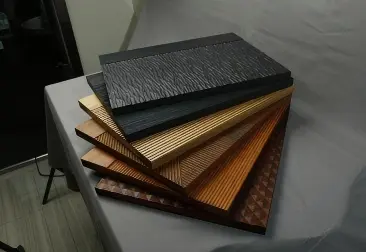
CNC-carved relief in solid timber — waves, ridges, mountain and fish-scale textures cut to any depth the board thickness allows.
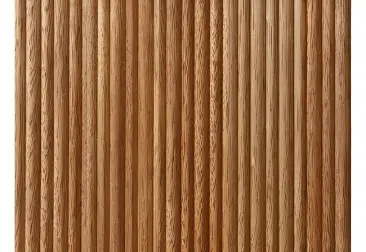
Concave, convex or sharp-ridge grooves at a fixed pitch, giving a continuous vertical rhythm across long runs.
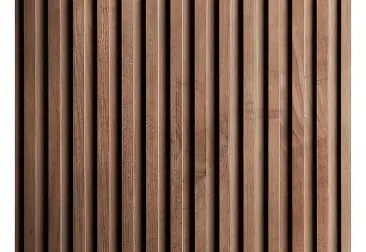
Separate slats on a backing board — the same construction as wood strip wall panels, sized to the project grid.
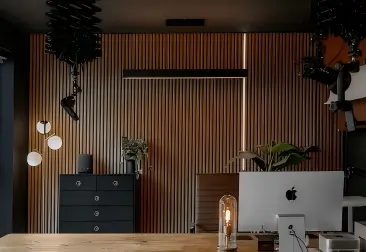
Slats bonded to acoustic felt or mounted over a cavity, including walnut acoustic slat panels.
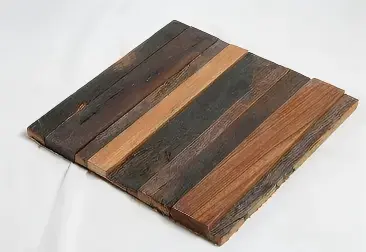
Small blocks laid to a geometric grid — hexagon, herringbone or random-depth — producing shadow and depth at close range.
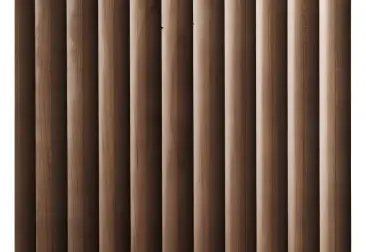
Flat or lightly profiled boards machined from solid wood throughout, so panels can be sanded and refinished later.
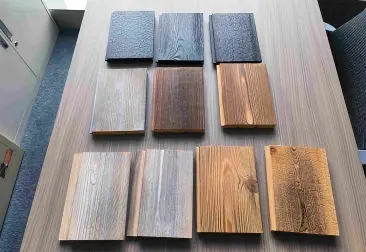
Shou Sugi Ban charred cladding
Boards burned, brushed and oiled by the Japanese Yakisugi method, in light, medium and deep char depths.
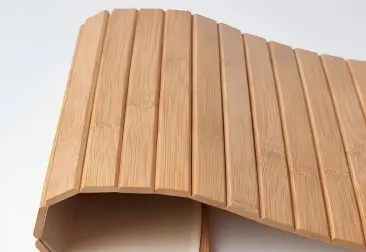
Kerfed or slat-on-flexible-backing construction that wraps columns, curved reception desks and radiused walls without segmenting.
Wood wall panels in production
-
![Wood Panel Wall Decor For Furniture]() Wood Panel Wall Decor For FurnitureIt often with gorgeous decorations, strong colors and exquisite shapes to achieve a graceful and luxurious decorative effectread more
Wood Panel Wall Decor For FurnitureIt often with gorgeous decorations, strong colors and exquisite shapes to achieve a graceful and luxurious decorative effectread more -
![3D Fluted Concave Decorative Wood Wall Covering Panels]() 3D Fluted Concave Decorative Wood Wall Covering PanelsMaintaining the beauty of solid wood parquet wall panels is also a breeze. With regular dusting and occasional polishing, you can keep your panels looking as good as new. Unlike other wall...read more
3D Fluted Concave Decorative Wood Wall Covering PanelsMaintaining the beauty of solid wood parquet wall panels is also a breeze. With regular dusting and occasional polishing, you can keep your panels looking as good as new. Unlike other wall...read more -
![Linear Wood Ceiling Panels]() Linear Wood Ceiling PanelsThis solid wood ceiling type is classified as modern style with features of modern, concise, comfortable, bright, functional, and warm. Every detail reflects modern characteristics.read more
Linear Wood Ceiling PanelsThis solid wood ceiling type is classified as modern style with features of modern, concise, comfortable, bright, functional, and warm. Every detail reflects modern characteristics.read more -
![Modern Shou Sugi Ban]() Modern Shou Sugi BanThis modern charred black Shou Sugi Ban cladding features a deep black finish with subtle crackle effects and pronounced vertical grain. Unlike heavily cracked surfaces, this version balances the...read more
Modern Shou Sugi BanThis modern charred black Shou Sugi Ban cladding features a deep black finish with subtle crackle effects and pronounced vertical grain. Unlike heavily cracked surfaces, this version balances the...read more -
![Light Brown Shou Sugi Ban]() Light Brown Shou Sugi BanThis light brown Shou Sugi Ban cladding showcases a natural carbonized surface with distinct wood grain and visible knots, enhancing its rustic charm. The warm, earthy tones highlight the wood’s...read more
Light Brown Shou Sugi BanThis light brown Shou Sugi Ban cladding showcases a natural carbonized surface with distinct wood grain and visible knots, enhancing its rustic charm. The warm, earthy tones highlight the wood’s...read more -
![Grey-Washed Shou Sugi Ban Long Strip Panel]() Grey-Washed Shou Sugi Ban Long Strip PanelThe Grey-Washed Shou Sugi Ban Panel offers a perfect balance between traditional Yakisugi craftsmanship and modern architectural aesthetics. Each board undergoes a light charring process, followed...read more
Grey-Washed Shou Sugi Ban Long Strip PanelThe Grey-Washed Shou Sugi Ban Panel offers a perfect balance between traditional Yakisugi craftsmanship and modern architectural aesthetics. Each board undergoes a light charring process, followed...read more -
![Brown-Toned Strip Shou Sugi Ban]() Brown-Toned Strip Shou Sugi BanThe Brown-Toned Shou Sugi Ban Panel redefines the beauty of traditional charred wood with a modern, earthy tone. Crafted through a precise medium-char burn and brushed finishing process, this...read more
Brown-Toned Strip Shou Sugi BanThe Brown-Toned Shou Sugi Ban Panel redefines the beauty of traditional charred wood with a modern, earthy tone. Crafted through a precise medium-char burn and brushed finishing process, this...read more -
![Natural Sanded Strip Shou Sugi Ban]() Natural Sanded Strip Shou Sugi BanThe Natural Sanded Shou Sugi Ban Wood Panel is a refined interpretation of the traditional Japanese Yakisugi technique. After light charring, each plank is carefully brushed and sanded to reveal a...read more
Natural Sanded Strip Shou Sugi BanThe Natural Sanded Shou Sugi Ban Wood Panel is a refined interpretation of the traditional Japanese Yakisugi technique. After light charring, each plank is carefully brushed and sanded to reveal a...read more -
![Deep Charred Strip Shou Sugi Ban]() Deep Charred Strip Shou Sugi BanThe Deep Charred Strip Shou Sugi Ban represents the most classic expression of the Japanese "Yakisugi" technique - where the wood surface is deeply carbonized to achieve a rich charcoal-black tone...read more
Deep Charred Strip Shou Sugi BanThe Deep Charred Strip Shou Sugi Ban represents the most classic expression of the Japanese "Yakisugi" technique - where the wood surface is deeply carbonized to achieve a rich charcoal-black tone...read more -
![Flat Surface Shou Sugi Ban Wood Panel]() Flat Surface Shou Sugi Ban Wood PanelThe Flat Surface Shou Sugi Ban Wood Panel embodies simplicity and authenticity. Crafted from premium natural cedar or pine, each plank showcases unique knots and grain patterns that reflect the...read more
Flat Surface Shou Sugi Ban Wood PanelThe Flat Surface Shou Sugi Ban Wood Panel embodies simplicity and authenticity. Crafted from premium natural cedar or pine, each plank showcases unique knots and grain patterns that reflect the...read more -
![Sharp Ridge Fluted Shou Sugi Ban]() Sharp Ridge Fluted Shou Sugi BanThe Sharp Ridge Fluted Shou Sugi Ban features a bold geometric rhythm with evenly spaced triangular ridges. Unlike traditional concave or rounded profiles, this design emphasizes a precise...read more
Sharp Ridge Fluted Shou Sugi BanThe Sharp Ridge Fluted Shou Sugi Ban features a bold geometric rhythm with evenly spaced triangular ridges. Unlike traditional concave or rounded profiles, this design emphasizes a precise...read more -
![Concave Fluted Natural Shou Sugi Ban]() Concave Fluted Natural Shou Sugi BanThe Concave Fluted Natural Shou Sugi Ban is characterized by its gently recessed vertical grooves, creating a soft interplay of light and shadow. Unlike convex fluted panels, this inward-curved...read more
Concave Fluted Natural Shou Sugi BanThe Concave Fluted Natural Shou Sugi Ban is characterized by its gently recessed vertical grooves, creating a soft interplay of light and shadow. Unlike convex fluted panels, this inward-curved...read more


How to choose the right wood wall panel
Construction determines where a panel can go. Interior finish panels, wet-area panels
and facade cladding are not interchangeable, even when the face texture looks identical.
| Panel type | Construction | Interior / exterior | Acoustic role | Installation | Best for |
|---|---|---|---|---|---|
| 3D carved panel | Solid timber, carved | Interior | Diffusion only | Adhesive or clip | Sculptural feature walls |
| Fluted / reeded panel | Solid timber or veneered core | Interior | Diffusion only | Adhesive or batten | Long continuous runs |
| Wood slat panel | Slats on backing board | Interior | Diffusion; absorption with felt | Screw or batten | Offices, corridors, ceilings |
| Acoustic slat panel | Slats + acoustic felt backing | Interior | Measured absorption | Batten over cavity | Meeting rooms, studios |
| Mosaic wood panel | Blocks on mesh or board | Interior | Diffusion only | Adhesive | Close-range detail walls |
| Solid wood panelling | Solid boards, T&G or square edge | Interior | None | Batten or clip | Refinishable long-life surfaces |
| Shou Sugi Ban cladding | Charred solid timber | Exterior and interior | None | Ventilated batten + drainage gap | Facades, weathered walls |
| Veneered MDF panel | Real veneer on MDF/HDF core | Interior, dry areas | Diffusion only | Adhesive or clip | Large flat spans, tighter budgets |
Two distinctions decide most specifications. First, solid wood versus engineered board: solid timber holds a deep carved profile and can be refinished; a veneered core stays flatter over wide panels and costs less. Second, sound absorption versus sound insulation — a grooved timber face reduces echo inside a room; it does not stop sound passing between rooms, and no decorative panel should be specified as soundproofing.
Wood species and panel construction
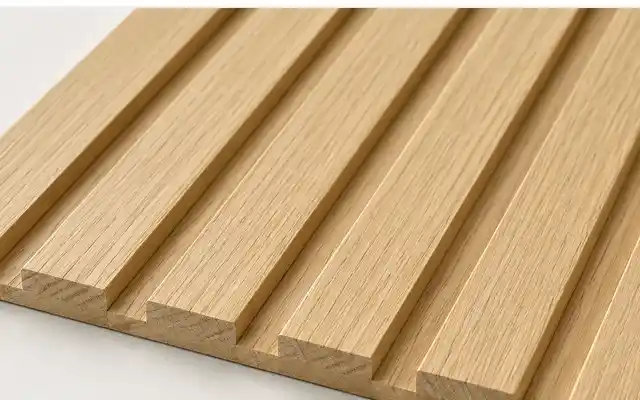
Pale gold · straight open grain
Slat & fluted, stain-to-order
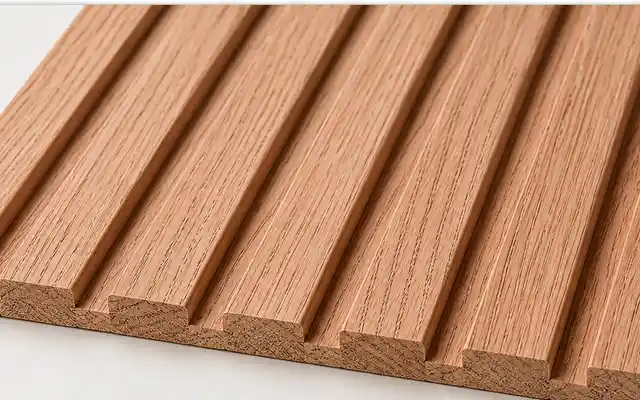
Red oak
Warmer pink cast · coarse grain
Budget interior panelling
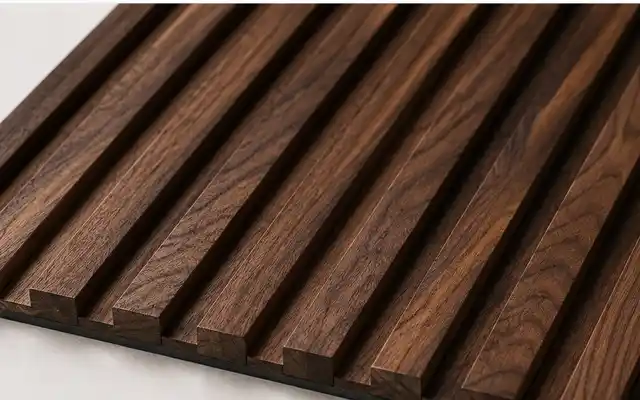
Deep chocolate · flowing figure
Premium feature & acoustic
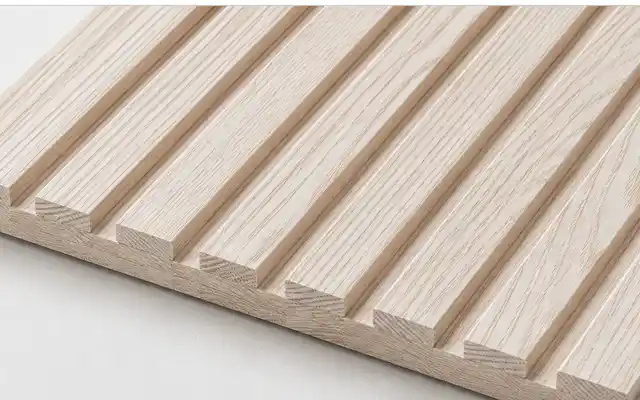
Ash
Near-white · prominent grain
Light interiors, carved relief
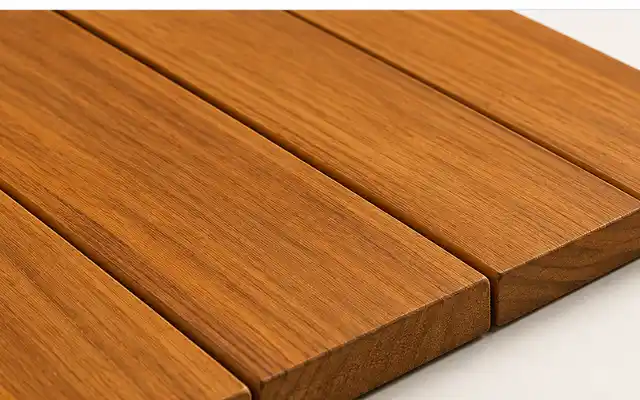
Golden brown · oily, stable
Humid climates, sheltered exteriors
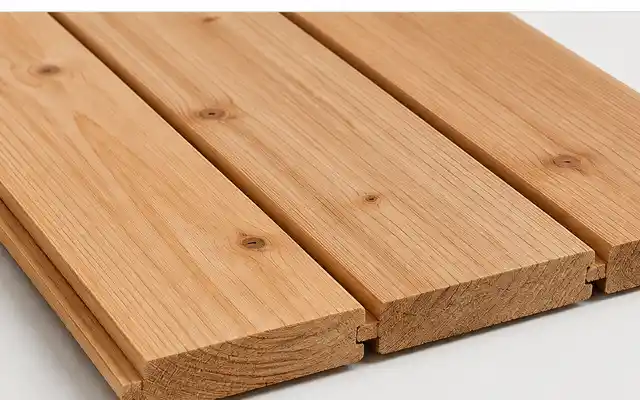
Cedar
Light · naturally durable
Charred cladding, exterior boards
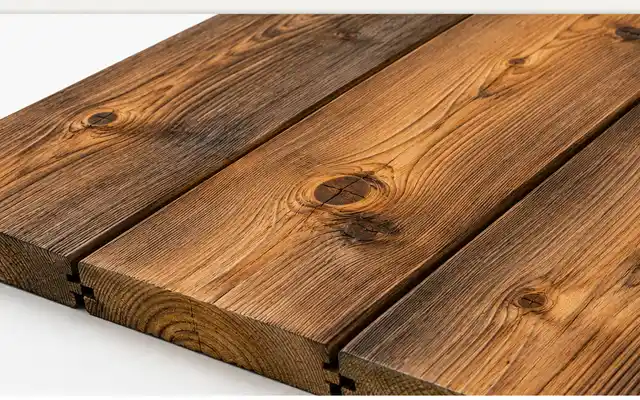
Larch / pine
Resinous · knotty character
Rustic charred & flat cladding
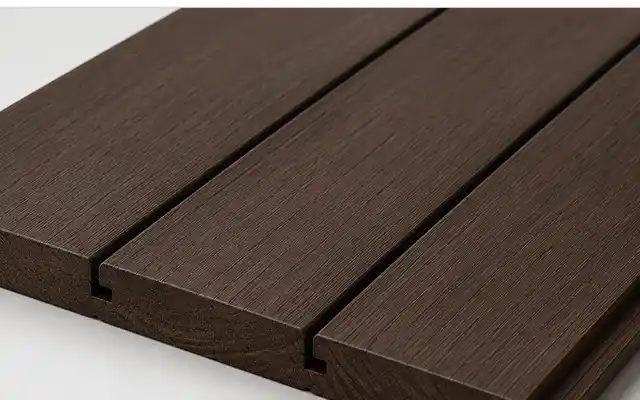
Thermally modified
Uniform darkened tone
Facades needing stability
Construction options
- Solid timber — one material through the section. Carries deep carving, can be sanded and refinished, moves more with humidity.
- Natural veneer on MDF or HDF core — real wood face on a stable core. Flattest option over wide panels; profile depth limited by veneer thickness.
- Veneer on plywood core — better screw holding and impact resistance than MDF, used where panels are removable.
- Engineered wood veneer — reconstituted to a repeatable grain, which removes batch-to-batch colour variation on large orders.
- Carbonised timber — surface or through-thickness heat treatment, for charred cladding and exterior stability.
Before anything is machined
Incoming timber is dried and checked for moisture content before it reaches a cutter. Panels machined at the wrong moisture level will cup or open at the joints on site, regardless of how well they were finished — which is why a beautiful sample and a failed installation can come from the same factory.
Boards are then sorted by tone, so that a single elevation is machined from a single tonal group rather than assembled from whatever came off the stack.
Sizes, profiles and surface finishes
| Charred cladding board | 4000 × 135 × 20 mm standard · custom lengths and widths cut to project |
|---|---|
| Interior panel size | Made to project dimensions from your elevation drawing |
| Machining tolerance | ±0.5 mm on CNC-cut profiles |
| Fixing battens | 25 × 45 mm timber keel at 600–1000 mm spacing (exterior cladding) |
| Groove profile | Fluted · concave · convex · linear · sharp ridge · custom tooling from drawings |
| Surface texture | CNC carved · brushed · sanded · charred · assembled mosaic |
| Finish system | Hardwax oil · wood wax oil · stain · UV lacquer · natural exterior oil (no chemical preservatives on charred boards) |
| Colour | Natural · custom stain · RAL / NCS matching where the substrate allows |
| Edge detail | Square · tongue-and-groove · shiplap · concealed joint · mitred corner |
| Acoustic build-up | 100% recycled PET acoustic core + E0-grade MDF + natural veneer or solid wood |
| Backing | None · PET acoustic felt · mineral wool over cavity |
| Installation | Adhesive · clip · screw · timber batten · metal subframe |
| Fire performance | Acoustic panels B1 rated · charred boards form a dense char layer that slows ignition and flame spread |
| Formaldehyde | E0-grade MDF core; natural oil and wax finishes |
| Certification | CE · FSC · SGS · ROHS |
| Service life | Charred exterior cladding 20–30 years with normal maintenance |
How a custom order runs
Drawings, reference images or a finish schedule received and reviewed against machinable profiles.
01
Species, panel sizes, groove profile and texture depth confirmed in writing.
02
Structure and installation method assessed against the substrate and wall build-up.
03
Colour chips and a full-size production sample of the actual profile produced.
04
Sample approved by the client and retained as the batch reference.
05
Batch production against the approved sample, with tone sorting before machining.
06
Panels inspected, dry-assembled where the layout is complex, then packed for freight.
07
Shop drawings, packing list and test reports issued with the shipping documents.
08
compliance
Formaldehyde emission — E0-grade MDF core; natural oil and hardwax finishes
Reaction to fire — acoustic panels B1 rated
Acoustic absorption — noise reduction coefficient up to 1.11.
Absorption band — PET core targets 1,000–4,000 Hz speech and activity noise
Machining tolerance — ±0.5 mm on CNC-cut profiles
Coating safety / VOC — low-VOC natural oil and wax; ROHS compliant
Timber traceability — FSC-certified timber options available
Certification — CE · FSC · SGS · ROHS
Charred cladding uses fire and natural oils only — no chemical preservatives — and carries a 20–30 year service life outdoors.
Installation systems
Exterior work is a different discipline from interior. Charred and thermally modified boards are fixed on ventilated battens with a drainage gap behind, so water that gets past the face can leave and the board can dry from both sides — the standard practice for installing carbonised wood cladding. Sealing a timber facade tight to a solid wall is the most common cause of premature failure we see.
Facade build-up: stainless or corrosion-resistant keel frame, 5 × 5 galvanised angle irons on expansion bolts, 25 × 45 mm timber keels run horizontally at 600–1000 mm centres, each board fixed with 3–4 anti-rust self-tapping screws. Seal cut edges and the back face with protective oil before fixing — that is where water gets in.
Internal and external corners, terminations and how a panel meets a door frame or ceiling are decided at shop-drawing stage, not on site. Section details, corner details and edge trims are issued with every project order, alongside the installation videos for each panel system.
Adhesive
flat, dry, sound substrates and lighter panels. Correct panel adhesive selection matters more than quantity; the wrong product telegraphs through thin veneer.
Clip and keel systems
heavy solid wood, and walls where panels must come off again for service access.
Screw fixing
acoustic panels take at least 9 screws per panel, roughly 80 mm apart horizontally and 600 mm vertically, driven through the felt. Match screw colour to the backing.
Timber battens
45 mm battens levelled on the wall. Filling between them with mineral wool takes the assembly to Class A sound absorption.
Light steel keel
keels set about 100 mm off the wall with verticals at roughly 600 mm centres, insulation between, panels screwed to the keel.
Tongue-and-groove / shiplap
closed joints on flat boards, allowing seasonal movement.
Applications by project type
Hotel lobbies and corridors — full-height carved or fluted panels, fire class specified, colour matched across large areas.
Reception and lift lobbies — continuous grain matching around corners and returns.
Restaurants, cafés and bars — mosaic and slat panels where echo control and durability matter together.
Ceilings and curved surfaces — linear wood ceiling panels and flexible panels wrapping columns.
Offices and meeting rooms — acoustic slat panels over a cavity, integrated with lighting and AV.
Facades and garden walls — charred or thermally modified cladding on ventilated battens.
Completed installations across these building types are recorded in the project case archive, with the panel type and finish used on each.
Factory and quality control
Factory and quality control
Finishing to a single stain lot per batch
Moisture content measured and logged per batch
Colour compared against the retained reference sample
Kiln drying or conditioning to the target range
Dry assembly of complex layouts before packing
CNC machining against the approved profile file
Carving depth and groove pitch spot-checked
Hand sanding and edge preparation
Wood wall panel FAQ
Q: What types of wood wall panels do you manufacture?
A: 3D carved panels, fluted and reeded panels, wood slat and acoustic panels, mosaic panels, flat solid wood panelling, Shou Sugi Ban charred cladding for exteriors, and made-to-drawing architectural panels.
Q: What is the difference between solid wood and veneered wall panels?
A: A solid wood panel is machined from timber throughout, so the profile depth is real and it can be sanded and refinished. A veneered panel is a thin layer of real wood pressed onto an MDF, HDF or plywood core, which stays flatter over large spans and costs less, but the face layer limits how deep a profile can be cut.
Q: Can panel sizes and profiles be customised?
A: Yes. Length, width, thickness, groove profile, texture depth, wood species, stain colour and edge detail are all made to order. Send a drawing, a reference photo or a project specification and we quote against it.
Q: What is the MOQ for custom wood wall panels?
A: MOQ is flexible and typically starts at 50–100 m² depending on the design. A catalogue profile carries a lower minimum than a newly tooled one, because a new profile means new cutters and a setup run.
Q: Do you supply samples before bulk production?
A: Yes. Standard samples are free with shipping at your cost, and custom samples are made to your specification. Sampling turnaround is around 3 days. A full-size production sample of the actual profile is then approved before the batch is released.
Q: How long does custom production take?
A: Standard production runs 15–30 days after order confirmation, with priority scheduling for urgent projects. Species availability, profile complexity and finishing system move the date — oiled finishes need cure time between coats, and charred finishes add burn, brush and oil stages.
Q: Do wood wall panels absorb sound?
A: Our acoustic panels use a recycled PET core behind an E0-grade MDF and veneer face, reaching a noise reduction coefficient up to 1.11 depending on the assembly tested. Measurable absorption comes from the complete build-up: slat geometry, felt or mineral wool backing, cavity depth and fixing method. Sound absorption reduces echo inside a room; it is not soundproofing and will not stop sound passing between rooms.
Q: Can wood wall panels be used in bathrooms or outdoors?
A: Interior panels are made for stable, conditioned spaces. For wet areas and facades, use thermally modified or charred timber with an exterior-grade finish, ventilated battens behind the boards, and a drainage gap, so the timber can move and dry.
Q: Which installation system should I choose?
A: Adhesive suits flat, dry substrates and light panels. Clip or keel systems suit heavy solid wood and any wall that needs later access. Timber battens or a metal subframe are used on uneven walls, on ceilings and on all exterior cladding.
Q: How do you control natural wood colour variation?
A: Boards are sorted by tone before machining, a batch is finished from a single stain lot, and an approved reference sample travels with the batch. Some variation is inherent to real timber; layout drawings can distribute it deliberately rather than letting it group.
Q: Can you manufacture from architectural drawings?
A: Yes. Send elevations, sections and a finish schedule. We return a shop drawing showing panel splits, corner treatment, edge details and fixing positions for approval before cutting.
Q: How long does Shou Sugi Ban cladding last, and what maintenance does it need?
A: Charred cladding lasts 20–30 years outdoors and longer indoors. The charred surface resists rot, insects and weathering without chemical preservatives. Left alone it weathers to a silver-grey patina; to hold the original black tone, reapply natural wood oil every 2–3 years outdoors. Clean with a soft brush or damp cloth — never pressure-wash.
Q: Which timber do you use for charred cladding?
A: European Red Pine, Larch, Mongolian Scotch Pine and Cedar. These species take the burn evenly and stay dimensionally stable afterwards. Standard board size is 4000 × 135 × 20 mm, with light, medium and deep char levels available.
Q: How are wood wall panels packed for sea freight?
A: Faces are film-protected, edges take corner guards, panels are bundled by profile and colour batch, then loaded into moisture-barrier lined cartons and fumigation-compliant wooden crates or pallets. Cartons are marked with project reference, profile code and batch number.

Send us your wall dimensions, drawings or reference design
We review material, profile, dimensions, installation method and quantity before preparing a quotation
Dongguan MUMU Woodwork Co., Ltd. is one of the most professional wood wall panel manufacturers and suppliers in China, featured by cheap products and good service. If you're going to wholesale customized wood wall panel at low price, welcome to get quotation and free sample from our factory. Contact us for more discount information.